November 4, 2026

7 minutes
A useful digital request for proposal, or RFP, explains the business outcome you need, the conditions a solution must meet, and the evidence you will use to choose a partner. It should also identify what you do not know yet. For a website, CMS, or AI initiative, that distinction helps you compare proposals without treating every early idea as a permanent requirement.
The challenge is that an RFP often asks an organization to specify the solution before it has done enough work to understand the problem. Stakeholders contribute requests; those requests become a spreadsheet, and vendors explain how many boxes they can check. The document looks thorough. The most important decisions may still be unresolved.
Why AI makes the feature list problem harder
AI makes it easier to produce a detailed RFP. It can organize stakeholder notes, suggest questions, and identify gaps worth discussing. But a well-written requirement is not necessarily a well-founded requirement. Asking AI to expand a list can turn a tentative idea into several pages of confident specification without adding any evidence that the business needs it.
The same problem appears on the other side of the purchase. An AI search feature, content assistant, or recommendation engine can be presented as something your next platform must include. Sometimes it should. Sometimes an existing tool, clearer content, or a simpler workflow could address the need. If the RFP has already chosen the mechanism, a vendor proposing a better approach may appear less compliant than one that agrees with the premise.
A detailed RFP can still be precise about the wrong thing.
Separate requirements from assumptions and future options
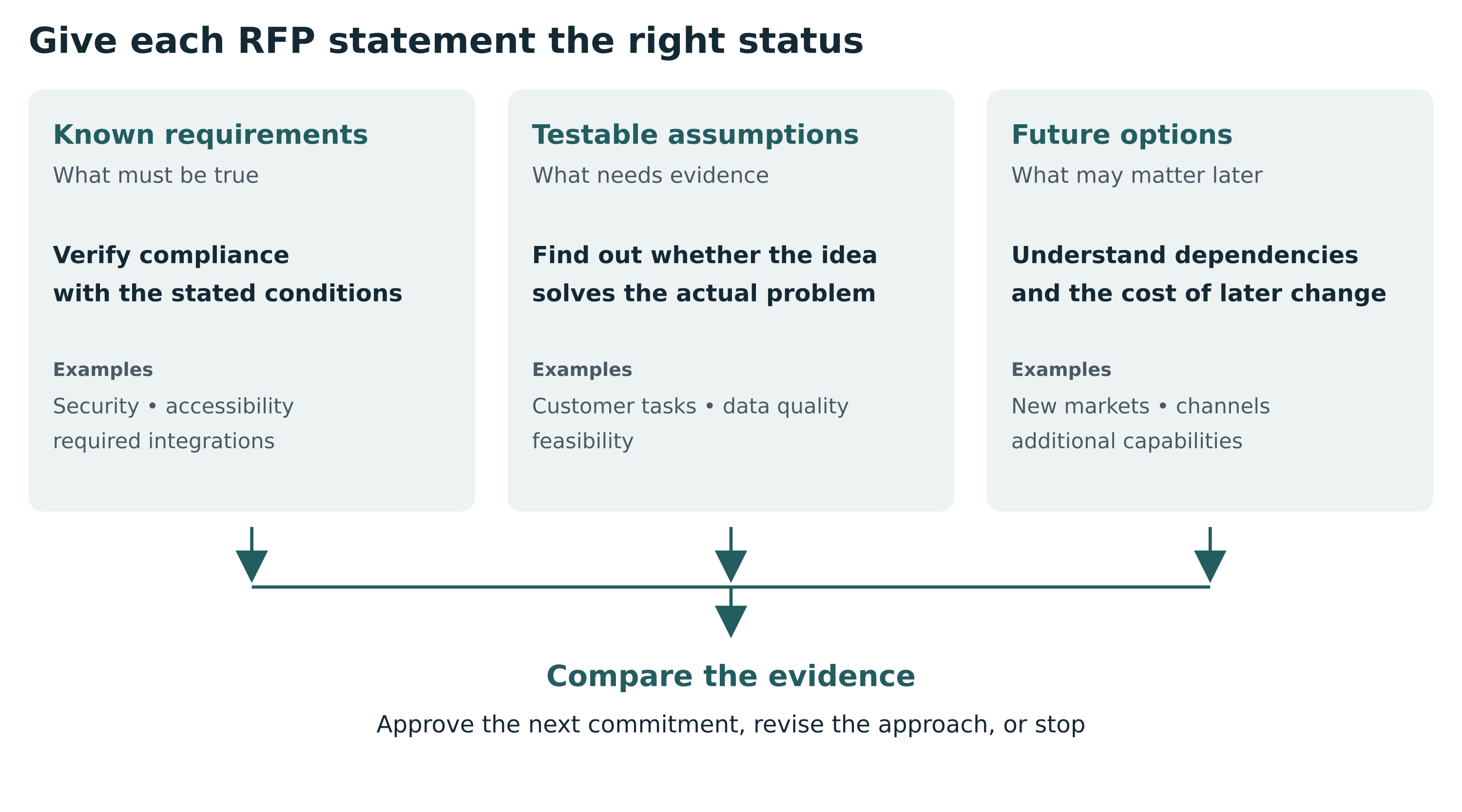
An outcome-led RFP keeps the desired result specific while allowing vendors to explain how they would achieve it. That does not mean abandoning requirements. It means giving each statement the right status before asking anyone to price it.
Known requirements are conditions a proposal must satisfy. They might include accessibility criteria, security controls, data-handling restrictions, required integrations, or a firm launch date. Document the reason for each and the evidence needed to verify compliance. Involve the people responsible for those decisions, including procurement, rather than letting the project team quietly redefine what is mandatory.
Testable assumptions are beliefs about what will improve the situation. For example, a conversational interface might help customers find the right product more easily. That is a reasonable possibility to investigate, not proof that a chatbot belongs in the implementation scope. State what you believe, why you believe it, and what finding would change your mind.
Future options are capabilities you may need later but have not justified buying now. Expanding to additional markets might matter eventually. Ask what that would require, what decisions would make it harder, and what costs would be deferred. For CMS selection, content and data portability can help preserve choices, but no architecture makes future change effortless. Keep these options visible without scoring them as though they are launch requirements.
Replace a feature request with a decision scenario
Consider a hypothetical manufacturer whose customers struggle to find current product specifications. Sales staff spend time locating documents and correcting inquiries based on outdated information. A feature-led RFP might say:
The new website must include an AI chatbot, semantic search, and automated product recommendations.
That describes a solution before establishing which part of the customer task is failing. A more useful request would give vendors a common scenario:
Help a customer identify the relevant product, find its current approved specification, and send an inquiry containing the correct product details. Using the supplied sample catalog and customer questions, demonstrate your proposed approach. Include an outdated document, an incomplete product record, and a question the available information cannot answer. Show how the customer reaches a useful next step in each case.
The RFP can then explain that the business wants fewer inquiries requiring avoidable clarification, without making it harder for customers to contact sales. It should supply any reliable baseline, identify gaps in that baseline, and ask how the proposed approach would be evaluated. Track task completion, accuracy of the selected information, and clarification of work alongside successful inquiry submissions and abandonment. Fewer clarification requests would not be a success if customers simply gave up.
A vendor could recommend better navigation, improved search, an AI-assisted experience, or a combination. Each would still need to meet the same mandatory conditions and explain dependencies such as catalog cleanup. The comparison becomes whether the approach fits the work, rather than whether the product contains the requested labels.
A demonstration can show how a capability handles those scenarios. It cannot establish that the business will achieve the projected improvement after launch. Use current capabilities or a documented walkthrough for early evaluation. Scope substantial custom testing separately rather than expecting a finished solution in a bid. Ask vendors to distinguish what they can demonstrate now from what requires a pilot with representative users, content, and operating conditions.
Make vendor answers comparable without making them identical
Allowing different approaches does not have to make procurement subjective. Give participating vendors the same context, scenarios, response structure, and evaluation criteria. Share material clarifications consistently through the agreed process. Keep mandatory requirements as explicit gates, then evaluate qualifying proposals against the outcomes and evidence that matter.
For each priority scenario, ask vendors to explain the proposed approach, the evidence supporting it, and the assumptions behind it. Require a clear distinction between available capability, configuration, custom development, third-party services, and roadmap promises. Ask what the client must provide and who owns the ongoing work. A confident answer should not score higher merely because it omits its dependencies.
Commercial responses need a common basis too. Specify common outcomes and project boundaries, the same planning period, and the same usage assumptions, with setup and recurring costs separated. Ask vendors to identify scope differences, exclusions, variable charges, client effort, and anything that could affect the estimate. Uncertainty should be visible enough to discuss, rather than buried inside a price that appears more definite than it is.
Ask vendors to show what they know, what they are assuming, and how they would find out the rest.
Buy a defined learning phase rather than an open commitment
Some unknowns are too important to resolve through written proposals or demonstrations. Perhaps no one has verified the condition of the product data or the feasibility of an integration. In that situation, a bounded discovery phase can be a legitimate purchase in its own right, subject to the organization’s procurement process. Its purpose is to answer specific questions that affect the next investment decision.
Define the questions, deliverables, responsibilities, schedule, and spending limit before work begins. The deliverable should be usable evidence: findings about the data, tested integration assumptions, evaluated solution options, and a revised scope with explicit dependencies. Agree on what would justify moving forward, changing direction, or stopping. Limit what you spend to establish value before funding the larger implementation.
Keep that next decision real. Commissioning discovery should not silently authorize the full build. Agree on access and rights to reuse the findings and working materials, including if another implementation partner is selected. Where a later competitive selection is planned, have procurement establish how relevant findings will be shared consistently. If the scope changes materially, update the comparison and approval process rather than treating the original estimate as a promise everyone must defend.
Where discovery would not materially change the decision, do not add it as a ritual. The point is to resolve consequential uncertainty, not to sell another phase or delay a well-understood project.
Write the RFP around the decision you need to make
Before issuing your next RFP, review the statements marked as requirements. Which are genuine conditions of success? Which are proposed solutions that still need testing? Which are future possibilities that should remain possible without being purchased today?
That review gives vendors room to contribute expertise while keeping the buyer in control of priorities, spending, and approvals. You do not need to predict every feature the organization might need. You need enough clarity to compare credible approaches, enough evidence to make the next commitment, and an explicit way to learn before making the commitments that follow.
Let's hop on a call to discuss taking your digital strategy to the next level. Schedule here:

