March 6, 2026

6 minutes
There’s a version of your organization living inside AI search systems right now.
It’s an image cobbled together from every public-facing page on your website – from your most brilliant thought leadership pieces on down to that regrettable blog series you did in 2016 that you’ve been meaning to archive.
AI search systems “think” they know who you are. What you do, who your customers are, and how you rank against your competitors. But what if AI search systems are wrong?
An AI doesn’t know if a page you meant to delete is outdated. It doesn’t know you’ve retired specific service offerings or capabilities if the pages are still live. It doesn’t know that your terminology has evolved. In fact, it doesn’t “know” anything outside of the source material you’ve made available to it.
For most organizations, the potential for being misrepresented in AI search is a problem they’ve yet to address. We’ve got a framework for that, but first – story time.
Digital Residue: What We Learned
Not long ago, we were evaluating whether to add an AI chatbot to the Diagram website.
With over a decade of blog content and hundreds of published articles, we felt the chatbot could ingest our content and have a deep, rich understanding of our company and would therefore represent us accurately. Wrong.
Initial testing revealed that when we asked foundational questions about Diagram, the responses were broadly accurate but off on the finer details. The system highlighted expertise in a long-defunct platform, framed us narrowly around a singular industry, and described outdated elements of our support model.
This was due to years of evolving language, shifting priorities, and repositioning efforts remaining publicly accessible and blending into what we came to call digital residue: a layered record of historical Diagram that was difficult to separate from present Diagram.
Launching a chatbot under those conditions would have amplified inconsistencies instead of resolving them. We needed an approach that improved alignment without eroding the search authority we had built. The goal wasn't to erase history, but to keep it from defining the present.
A Practical Framework for AI-Ready Content
It’s tempting to treat AI readiness like one of those old SEO checklists: update a page here, remove something there, adjust some metadata, and then slap your hands together and move on. But this is not that. Without an understanding of which content most strongly shapes a public narrative, checklist-style efforts can be inefficient or even counterproductive.
It’s more effective to approach from a data-backed angle. Identify the content most likely defining you in search and AI-generated summaries, conduct some tests, and refine.
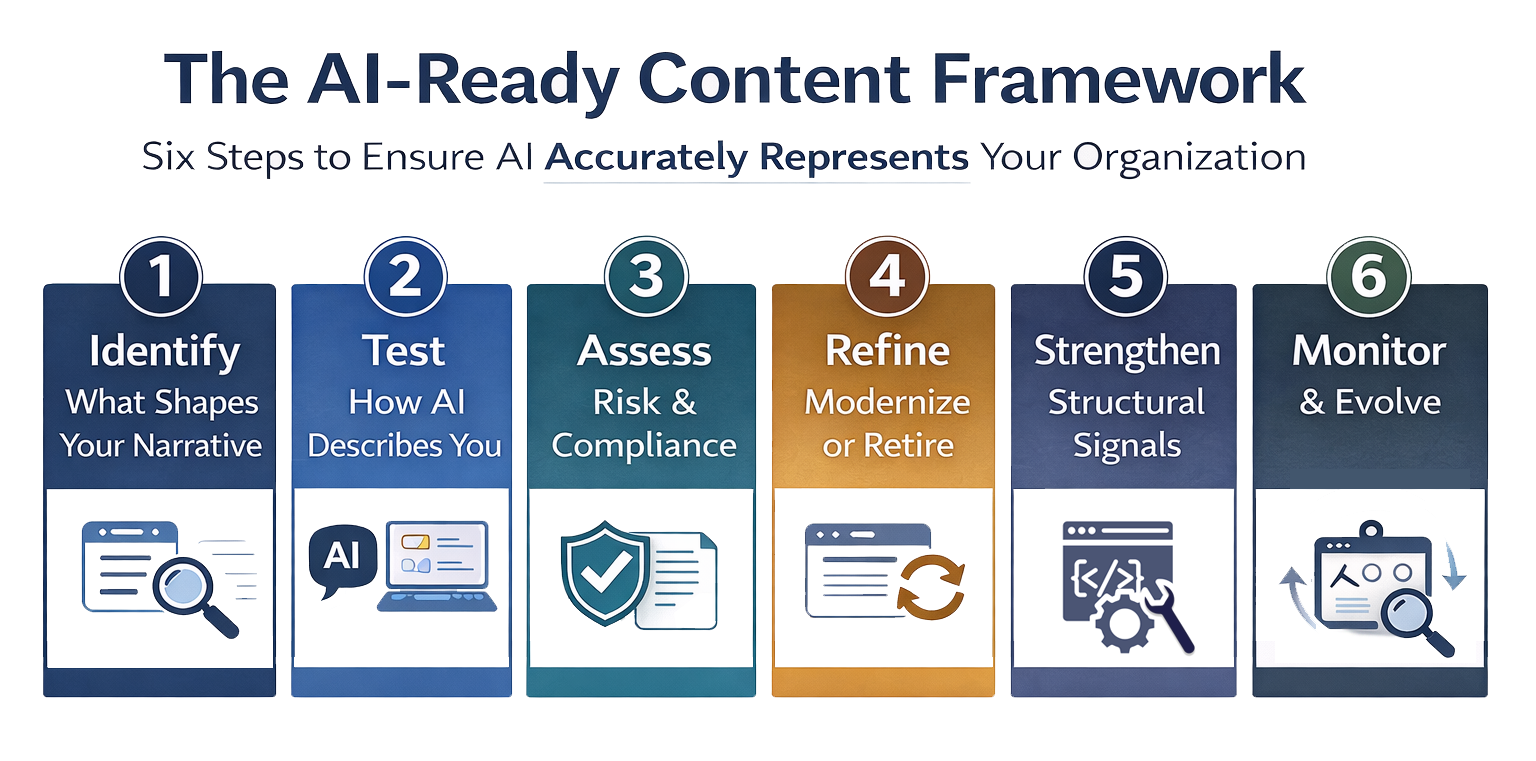
Step 1: Identify What Most Shapes Your Narrative
Start by understanding not just what content exists, but how it influences AI interpretation. Get into your website’s analytics and dig around, remembering that not all content carries equal weight.
Look specifically at the traffic from AI search agents. What search terms are driving traffic? What pages are the most traveled, and is their content current and accurate? In a predominantly zero-click search environment, where AI-generated summaries often reduce or replace the need to visit websites, your most high-authority pages are the ones to optimize first.
However, influence is not limited to your top-performing pages. Long-tail content such as older blog posts, legacy service pages, and niche industry articles all contribute to the broader narrative around your brand. Even pieces with modest traffic can reinforce terminology, positioning, or capability signals over time. This is where the digital residue lurks.
Step 2: Test How AI Describes You
Ask AI search agents direct questions about your organization: what you do, who your customers are, how you stand against competitors, and how you’re categorized. Then add industry, capability, and competitive prompts for nuance.
Review the outputs and look for patterns. Is outdated terminology showing up? Services you no longer offer? Do responses blend positioning or thought leadership from different stages of your org’s evolution? This is where the digital residue becomes visible.
If the narrative is off, the problem is rarely a single page. It usually indicates that residue content is influencing how AI understands you.
Step 3: Conduct a Risk and Compliance Review
In regulated or high-liability environments such as healthcare, finance, and legal services, misalignment is not only strategic. It can create real exposure.
AI agents tend to restate information with brazen confidence and often without the qualifiers or time-bound context present in original materials.
Review all content that includes regulatory information or citations, financial claims, technical specs, security standards, privacy and data information, and medical or advisory language. Outdated information or overbroad statements in these areas can lead to unintended consequences.
Involving legal, compliance, and risk stakeholders where appropriate helps keep governance aligned with how you’re being represented in AI outputs.
This is not simply a content refresh – it's a necessary part of enterprise risk management.
Step 4: Decide What to Update, Consolidate, or Retire
Once you understand influence and risk, you can make deliberate decisions about what to update. This is usually the most time-intensive step, but it’s also the most impactful.
High-performing content, especially pages that rank well or earn backlinks, should be updated rather than removed. Updating positioning, refining terminology, and aligning examples can preserve search performance while also correcting misalignment.
Residue also needs targeted attention. Some content may not be factually wrong, but it reinforces outdated positioning by overemphasizing a legacy capability, anchoring you to a narrow industry, or repeating language you have intentionally retired. Even low-traffic pages can distort your narrative when their themes accumulate.
Addressing residue may involve consolidating overlapping pages into a single resource, redirecting outdated pages to current equivalents, refreshing terminology, and remapping internal links to support current strategic priorities.
The goal is coherence – strong signals, less noise.
Step 5: Strengthen the Signals AI Agents Interpret
Updating copy is not enough. Once you have modernized, consolidated, or retired the right material, you need to ensure that machines can interpret what you have built. AI systems look at the architecture around your words as well as the words themselves.
Audit schema markup that clarifies page types, metadata that reflects correct positioning, internal links that reinforce the appropriate pillar pages, and authoritative citations that ground claims in current, credible sources.
These elements are less visible to readers, but they strongly influence how machines interpret your expertise and authority.
Step 6: Retest and Monitor Over Time
Content governance is ongoing work. After you implement updates, return to the same prompts you used during testing and check whether the narrative is more accurate and cohesive. Monitor real user inquiries as well. Questions about pricing, integrations, compliance, or scope often show where clarity still needs to improve.
Control Your AI Search Narrative
Without the work detailed above, AI search agents will continue feeding users the image of your organization that they've constructed from whatever you've left lying around - defunct platforms, retired services, and yes, that regrettable 2016 blog series. Right now, they're controlling the narrative.
The framework above puts you in front of all that. And in our next post, we'll look at how AI can be applied to this problem directly - and what we've been building to make sustained content governance practical at scale.
